
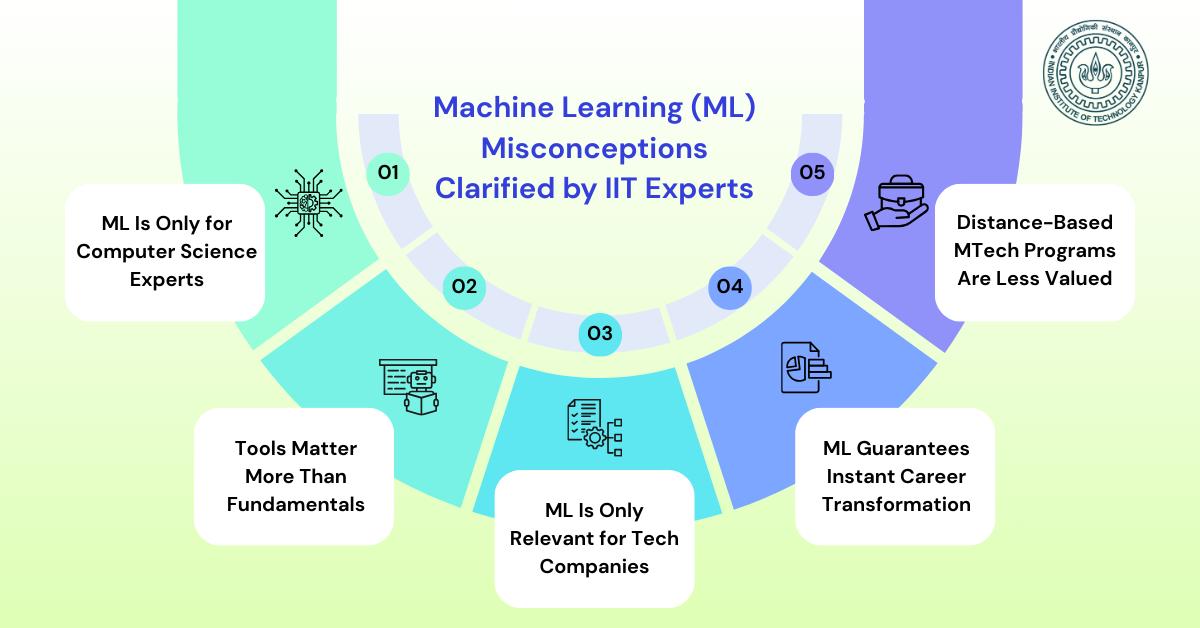
Machine Learning (ML) is no longer confined to research labs or technology giants. It now influences decision-making across finance, healthcare, manufacturing, retail, logistics, and public systems. Despite this widespread adoption, many working professionals hesitate to formally enter the ML domain. The hesitation often stems from misconceptions rather than actual barriers. Faculty members at institutions such as IIT Kanpur frequently observe that professionals underestimate their ability to transition into ML. The challenge is rarely intelligence or capability — it is clarity of direction and structured guidance.
Misconception 1: ML Is Only for Computer Science Experts
One of the most common assumptions is that Machine Learning is exclusively for computer science graduates. In reality, ML is inherently interdisciplinary. Professionals from electronics, mechanical engineering, mathematics, economics, statistics, and even management backgrounds successfully transition into ML roles. What matters more than degree labels is analytical ability and willingness to engage with data-driven thinking. Structured academic programs help bridge knowledge gaps systematically. Through IIT Kanpur’s online M.Tech. programmes, learners strengthen their mathematical foundations, statistical reasoning, and algorithmic understanding before advancing into complex ML models. For working professionals, this structured progression makes the shift manageable rather than overwhelming.
Misconception 2: Tools Matter More Than Fundamentals
The rapid evolution of ML frameworks often creates confusion. New tools, libraries, and platforms emerge constantly, giving the impression that staying updated is nearly impossible. However, IIT experts emphasize that tools change — principles do not. Core concepts such as probability theory, optimization, linear algebra, and model evaluation remain central regardless of technological shifts. Professionals who build strong fundamentals adapt more easily to evolving ecosystems. This is why the best online M.Tech. programs in India prioritize conceptual clarity before focusing on implementation tools. For long-term career stability, understanding “why” a model works is more valuable than memorizing “how” to run it.
Misconception 3: ML Is Only Relevant for Tech Companies
Another common misunderstanding is that Machine Learning careers are limited to technology firms or product-based companies. Many professionals working in traditional industries assume ML has little relevance to their domain. In reality, ML applications now extend far beyond pure technology sectors. Manufacturing relies on predictive maintenance models. Financial institutions use ML for risk assessment and fraud detection. Healthcare systems apply it for diagnostics and patient data analysis. Even supply chain and operations teams use ML-driven forecasting models to improve efficiency. IIT experts often emphasize that ML is not an industry-specific skill — it is a decision-enabling capability. Professionals who understand how to apply ML within their domain expertise create far greater value than those who approach it purely as a technical discipline. This broader applicability makes ML a strategic skill, not just a technical specialization.
Misconception 4: ML Guarantees Instant Career Transformation
While Machine Learning is a high-growth domain, it is not a shortcut to overnight success. Some professionals expect immediate role changes or dramatic salary jumps after brief exposure to ML concepts. IIT faculty often highlight that ML expertise develops progressively. Meaningful career growth comes from consistent learning, project exposure, and the ability to apply models to real-world business or technical problems. Programs ranked among the best online M.Tech. options in India integrate real datasets, case studies, and applied assignments. This ensures learners gain practical competence rather than surface-level familiarity. The focus is not on quick transitions, but on sustainable advancement.
Misconception 5: Distance-Based M.Tech. Programs Are Less Valued
The phrase “M.Tech. distance” once carried ambiguity regarding credibility. However, structured and accredited programs from IIT Kanpur have significantly redefined this perception. Employers increasingly evaluate candidates based on skills, institutional credibility, and demonstrated problem-solving ability rather than the delivery format. Interactive sessions, continuous evaluation, and hands-on coursework have made modern M.Tech. distance programs academically robust and industry-aligned. For working professionals, this evolution means that upgrading qualifications no longer requires career disruption.
The Industry Perspective
Organizations across sectors are embedding ML into operational and strategic decision-making. Global companies such as Google, Microsoft, and OpenAI continue to expand ML-driven capabilities, while Indian enterprises and startups are building domain-specific ML solutions. This sustained adoption creates long-term demand for professionals who understand both theory and application. However, employers seek depth, not superficial familiarity with buzzwords. Structured postgraduate education ensures that professionals build expertise aligned with evolving industry expectations.
Conclusion
Machine Learning is not inaccessible, nor is it reserved for a select academic group. Most barriers are perceptual rather than practical. With disciplined learning, strong fundamentals, and credible academic guidance, professionals from diverse backgrounds can transition into meaningful ML roles. IIT Kanpur’s online M. Tech. in Wireless Networks and Machine Learning program demonstrate how rigorous, flexible education can help working professionals move beyond misconceptions and build future-ready expertise. In a rapidly transforming technological landscape, clarity and structured learning make all the difference.