
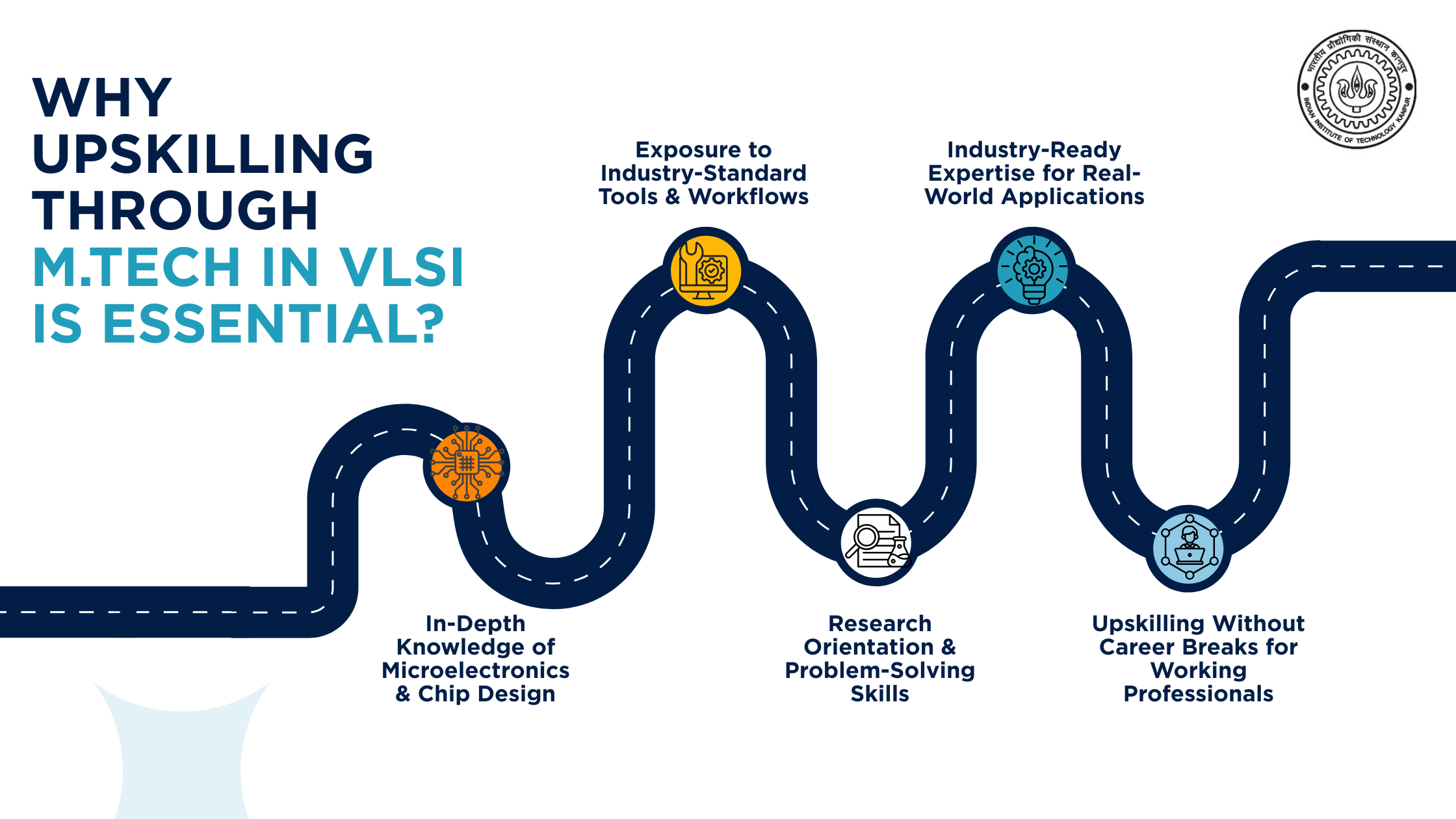
India’s semiconductor landscape is undergoing a significant transformation. With initiatives such as Make in India and Semicon India, along with global manufacturers expanding operations within the country, India is steadily positioning itself as a serious player in chip design and manufacturing. At the heart of this transformation lies one critical discipline: VLSI (Very Large Scale Integration).
For working professionals in electronics, electrical engineering, embedded systems, and related domains, this shift presents a clear opportunity. An M.Tech. in VLSI is no longer just an academic qualification—it is a strategic investment in long-term career relevance.
Why VLSI Matters More Than Ever
Semiconductors power nearly every modern device — smartphones, electric vehicles, 5G infrastructure, medical electronics, AI hardware, defence systems, and industrial automation. As India aims to strengthen its domestic design and fabrication capabilities, the need for skilled VLSI engineers is rising rapidly.
The industry is not simply looking for engineers who can execute tasks. It requires professionals who understand the complete chip design lifecycle — from device physics and circuit design to verification, layout, and system integration. This depth of knowledge is what differentiates contributors from leaders in semiconductor organizations.
VLSI engineers play key roles across:
- Logic and circuit design
- ASIC and SoC development
- Physical design and verification
- Embedded system integration
- Testing and manufacturing support
As demand increases and talent supply remains limited, the value of specialized expertise continues to grow.
Career Opportunities After an M.Tech. in VLSI
The semiconductor ecosystem today extends far beyond traditional chip companies. Automotive electronics, telecommunications, AI hardware firms, aerospace, defence research, and deep-tech startups all depend on VLSI expertise.
Professionals with advanced specialization typically move into roles such as VLSI Design Engineer, Physical Design Engineer, Verification Engineer, ASIC/SoC Engineer, or FPGA Developer. With experience and deeper technical grounding, career paths expand into system architecture, product engineering leadership, and research-focused roles.
Importantly, the compensation and growth trajectory in VLSI reflect the strategic importance of the field. As India accelerates its semiconductor ambitions, engineers equipped with advanced qualifications are positioned to take on high-impact roles in both domestic and global markets.
The Technology Driving Modern Connectivity
Consider the complexity behind something as routine as a high-speed 5G connection in a crowded stadium. The reliability and performance users experience depend on advanced RF and microelectronics technologies working seamlessly together.
Technologies such as millimeter-wave communication, massive MIMO architectures, and beamforming are enabled by sophisticated VLSI and microelectronics design. Engineers trained in advanced semiconductor concepts understand how these systems are architected, optimized, and implemented at the silicon level.
This is why surface-level exposure is rarely sufficient. The semiconductor industry demands precision, tool proficiency, and strong fundamentals in device physics, CMOS technology, and integrated circuit design. Structured postgraduate education helps build this depth systematically.
Why an Online M.Tech. Degree Program Makes Sense for Working Professionals
For many professionals, stepping away from work to pursue a full-time degree is not practical. At the same time, relying solely on on-the-job learning may limit long-term advancement in a technically demanding field like VLSI.
An Online M.Tech. Degree Program offers a balanced pathway, enabling engineers to strengthen conceptual foundations while continuing to gain industry experience. This combination of structured academic learning and real-world exposure creates a powerful advantage in the semiconductor job market.
As India’s semiconductor ecosystem matures, those who proactively deepen their expertise today are likely to shape design teams, research initiatives, and product innovation tomorrow.
IIT Kanpur Online M.Tech. in Microelectronics & VLSI
Among the leading programs in this space, the IIT Kanpur Online M.Tech. in Microelectronics & VLSI stands out for its academic rigor and industry alignment. Designed specifically for working professionals, IIT Kanpur Online Post Graduate Degree Programs combine flexibility with the credibility of an IIT qualification.
The curriculum covers core areas such as semiconductor devices, CMOS technology, advanced VLSI design, and microelectronics, delivered by faculty actively engaged in research and innovation. The structure allows professionals to enhance their expertise without disrupting their current career trajectory.
For engineers who want to contribute meaningfully to India’s semiconductor growth — not merely observe it — this program provides a structured and credible pathway forward.
India’s chip revolution is progressing steadily. The opportunity now lies in being technically prepared to participate in it at a deeper level.