
Behind every intelligent device and high-speed digital interaction lies a sophisticated semiconductor chip — engineered through advanced VLSI design — enabling everything from secure facial recognition to AI-driven decision-making in milliseconds.
VLSI is far more than a technical specialization; it is the core engineering discipline that powers modern electronics. From compact consumer devices to advanced computing systems, billions of transistors integrated onto a single chip deliver the speed, efficiency, and intelligence that define today’s digital world.
For professionals in electronics, electrical engineering, embedded systems, and allied domains, VLSI is not merely an academic subject — it represents a strategic and future-oriented career pathway in a rapidly expanding global semiconductor ecosystem.
Why VLSI Matters More Than Ever
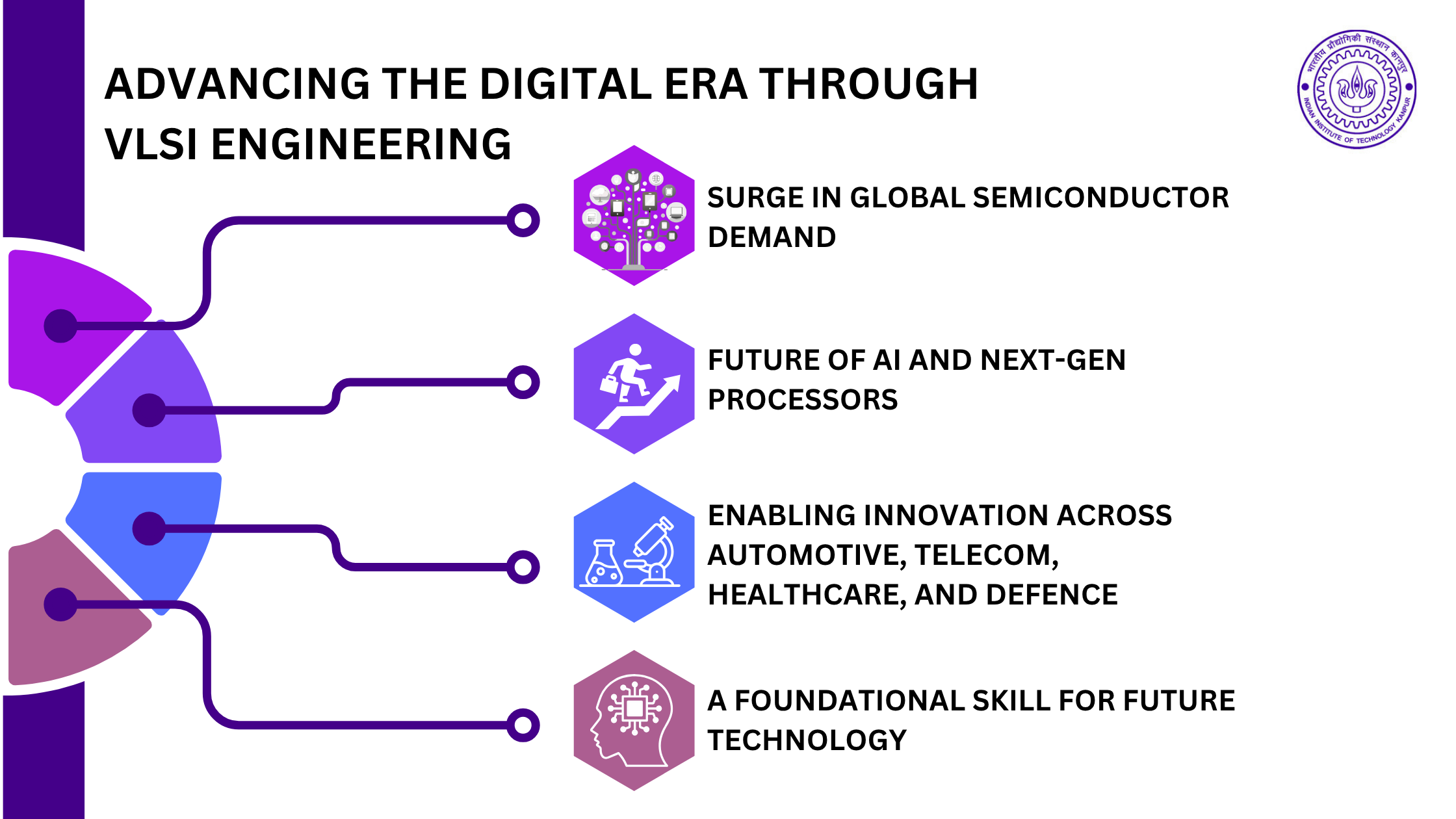
The global semiconductor ecosystem is expanding rapidly. Governments are investing heavily in chip manufacturing infrastructure. Technology companies are racing to design faster processors, energy-efficient systems, and specialized AI hardware. At the center of this expansion lies a critical gap: the need for engineers with deep expertise in chip design and microelectronics.
VLSI professionals are involved in the full lifecycle of chip development — from architecture and circuit design to verification, fabrication awareness, and system integration. The impact of their work spans industries including consumer electronics, automotive, telecommunications, defence, healthcare, and high-performance computing.
This is not a niche skill. It is foundational to the next wave of technological growth.
Career Pathways in Microelectronics and VLSI
A strong foundation in VLSI opens multiple high-value career tracks. Depending on specialization and experience, professionals can move into roles such as:
- IC Design Engineer
- SoC Architect
- Verification Engineer
- Semiconductor Process Engineer
- Embedded Systems Specialist
- Research and Development Engineer
What differentiates long-term growth from short-term placement is depth. Engineers who understand device physics, circuit theory, design methodologies, and semiconductor processes are better positioned for senior technical and leadership roles.
In a fast-moving industry, continuous upskilling is not optional but essential in the modern world.
Bridging the Industry Skill Gap
Technology in the semiconductor domain evolves rapidly. Design tools are upgraded, fabrication nodes shrink, and system complexity increases. Engineers who rely solely on earlier academic qualifications may find it challenging to keep pace with emerging demands.
A structured postgraduate program helps bridge this gap by reinforcing core fundamentals while integrating practical exposure to modern design environments. It enables professionals to connect theoretical knowledge with real-world engineering challenges.
An Online M.Tech. Degree Program in Microelectronics and VLSI is specifically structured to provide this depth. It strengthens conceptual clarity in areas such as microelectronics, VLSI design methodologies, semiconductor devices, and system-level integration — all of which are critical for advanced roles in the industry.
Advancing Without Stepping Away from Work
For many working professionals, the biggest barrier to higher education has traditionally been time. Leaving a full-time role to pursue a postgraduate degree is often impractical.
The IIT Kanpur Online M.Tech. in Microelectronics and VLSI addresses this challenge directly. Designed for working engineers, the program offers a flexible learning format that allows participants to continue their careers while upgrading their technical capabilities. The curriculum maintains academic rigor while remaining aligned with real-world semiconductor applications.
What distinguishes IIT Kanpur Online Degree Programs is the strength of the institution itself — research-led learning, academic depth, and the credibility associated with an IIT qualification. Professionals gain not only updated technical knowledge but also the confidence and recognition that come with structured advanced education.
Building the Technology of Tomorrow
The next generation of technological advancement — including AI accelerators, high-speed communication networks, smart mobility systems, and energy-efficient computing platforms — will be driven by increasingly sophisticated semiconductor design. Every major innovation in hardware is built upon the expertise of engineers who can conceptualize, design, and optimize silicon at scale.
For professionals who aspire to move beyond application-level implementation and contribute to core technology development, Microelectronics and VLSI provide a clear and strategic pathway. It enables a transition from deploying technology to engineering the fundamental systems that power it.
To support this transition, IIT Kanpur offers Online M.Tech. programs in these domains, specifically structured for working professionals. These programs allow learners to deepen technical expertise and strengthen career prospects while continuing in their current roles.